
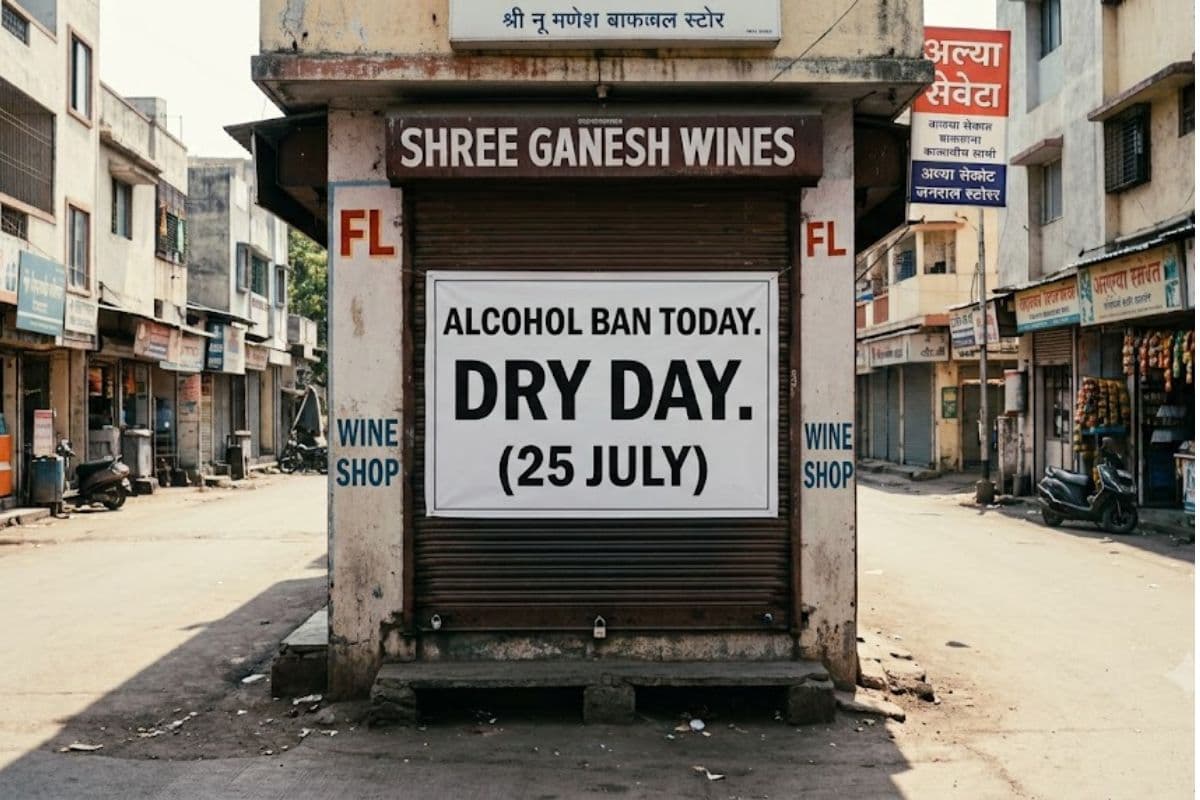
Planning a party, family dinner, or night out with friends this Saturday? Well, you might need to adjust your plans. This is because a state-wide restriction on the serving and sale of alcohol, which is also known as a dry day, will be enforced on Saturday, 25th July 2026. This restriction will be applied across major urban centers in Maharashtra like Pune, Thane, Nashik and Mumbai. Yes, you read that right. Here’s everything you must know about this upcoming dry day in detail.
A dry day is a designated period when the sale of alcohol is restricted or prohibited in a particular city, region, or state. They are usually announced on national holidays, election days, religious festivals, and important state observances. This temporary prohibition is announced by the state excise department.
Service or Establishment | Status on Dry Day |
FL-II Outlets and Retail Wine Shops | Closed |
Microbreweries and taprooms | Closed or don't serve alcohol |
Local bars, Permit rooms and Pubs | Closed or don't serve alcohol |
Five-star hotels or international airports | Restricted |
Restaurant and Dining outlets | Open (only food and soft beverages) |
.jpg&w=1920&q=75)
Also Read: July 2026 Dry Days In India: Complete List & What You Need To Know
The primary reason behind the temporary liquor restriction or ban on Saturday, July 25th, is the religious observance of Ashadhi Ekadashi.
Ashadhi Ekadashi is also known as Devshayani Ekadashi and is one of the most significant spiritual observances in Maharashtra’s cultural calendar. It marks the conclusion of the famous Wari Pilgrimage or Palkhi Sohala. During this pilgrimage, millions of devotees of Lord Vitthal, also known as Warakris, walk hundreds of kilometers on foot to visit the holy temple in Pandharpur in Maharashtra’s Solapur district.
According to the Hindu tradition, Devshayani Ekadashi or Ashadhi Ekadashi signifies the day when Lord Vishnu goes into a Yoganidra. Yoganidra is four months of cosmic sleep or slumber. To mark this sacred occasion, millions of people fast, visit temples, and sing bhajans across Maharashtra.
So, in order to respect the culture and religious sentiments of the people, to maintain solemnity, and to manage the massive influx of pilgrims traveling to the temple, the state excise departments and local administrations issue a dry day. This dry day is issued under the Maharashtra Prohibition Act.
The intensity of local enforcement can vary based on the individual area’s municipal collector mandates. But the following are the major metropolitan and urban areas that will be affected by this temporary prohibition:
Solapur & Pandharpur: Both Solapur and Pandharpur are the epicenter of the festival experiences. Hence, these towns will face total prohibition, and restrictions will be strict. This is to manage crowd safety and law enforcement.
Nashik & Chhatrapati Sambhajinagar: these urban centers witness high temple footfalls; hence, they may observe full or partial bans on commercial liquor spots.
Pune & Pimpri-Chinchwad: These areas are key transit corridors for the pilgrimage routes; hence, strict excise checks are routinely conducted here.
Mumbai Metropolitan Region (MMR): This includes Mumbai Suburban, Navi Mumbai, Thane, Kalyan-Dombivali.
Also Read: No More Dry Days? Maharashtra Permits Alcohol Sales On Holi, Muharram, And Gandhi Jayanti
Major places in Maharashtra will be observing a dry day on July 24th, 2026, on account of Devshayani or Ashadhi Ekadashi. Make sure you take note of the dry days well in advance before planning any outing or gathering that includes alcohol.