
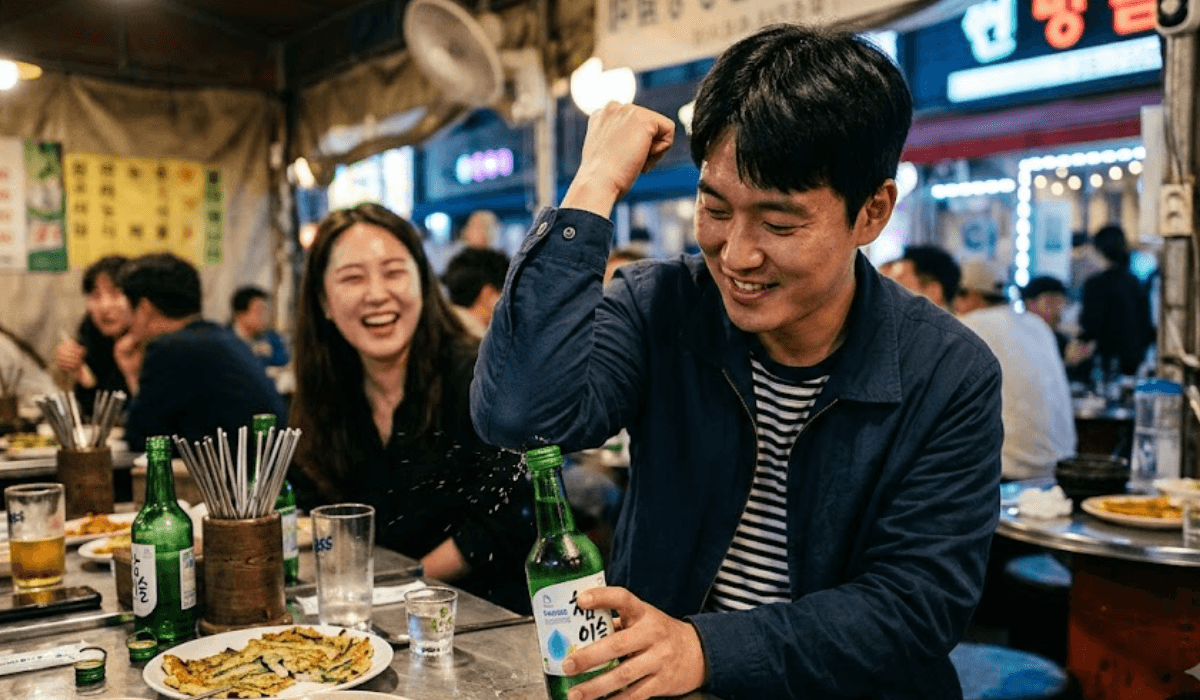
If you have watched enough Korean dramas, you have probably seen the same little performance before a bottle of soju gets opened. Someone picks up the familiar green bottle, gives it a good shake, creates a tiny whirlpool inside, taps the bottom with an elbow and then flicks the bottle near the neck before finally opening it.
For someone seeing it for the first time, it can look like a drinking game, or maybe just something people do because it looks cool. There is actually a story behind it, although the history is not quite as straightforward as social media videos sometimes make it sound. The ritual is generally linked to the days when soju bottles were sealed with corks, and traces of that old habit have survived even though modern bottles use screw caps.
The most commonly repeated explanation goes back to mid-20th-century Korea, when soju bottles were sealed with cork rather than the metal caps used today.
The problem was pretty simple. Cork could crumble, leaving small pieces behind in the bottle. So people developed ways of getting those unwanted bits towards the top before pouring the drink. Shaking or swirling the bottle helped move the contents around, while tapping the base and neck became part of the process of opening and clearing the bottle.
There are slightly different versions of this story. As per Korea.net, the bottle was shaken partly to soften the cork and make it easier to remove, while others focus on getting cork particles or sediment to the top so they could be discarded. It is worth saying that this is widely repeated folk history rather than something for which there is one definitive historical record.
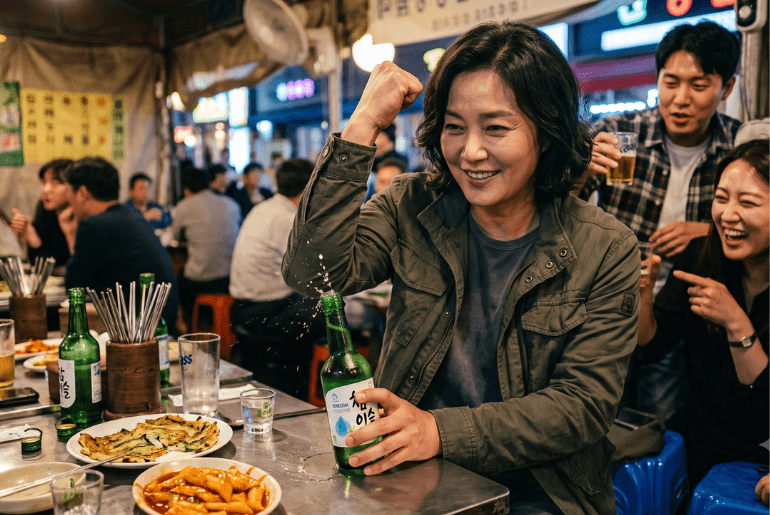
And that is probably why the ritual has survived in such a recognisable form. The original practical reason disappeared, but the gesture stuck around.
Also Read: Is Soju Stronger Than Vodka? How The Two Spirits Compare
The bottle is first shaken or spun until the liquid forms a small vortex. Some people give the bottom a tap with the palm or elbow. After the cap is opened, the neck can be tapped and the bottle flicked in a way that sends a small amount of liquid out.
The modern version is much more about the ritual than removing cork. There is no cork sitting inside a contemporary Jinro or Chum-Churum bottle waiting to ruin your drink.
In fact, a Korean drinking guide published in 2026 still lists techniques such as the elbow tap, bottle spinning and even soju-cap games as part of the broader culture around drinking soju.
So if somebody does the dramatic tornado with the bottle today, they are not necessarily trying to clean the drink. They are keeping alive a familiar piece of drinking culture, and, let's be honest, showing off a little bit too.
Also Read: What Is Soju? Korean Alcohol Explained
The spinning part is probably the bit that has become most recognisable outside Korea. You hold the bottle, give your wrist a quick movement and stop it sharply enough to create a whirlpool inside.
It looks surprisingly impressive when someone knows how to do it. When you don't know how to do it, there is always the possibility of getting a bottle flying across the table, which is considerably less impressive.
Some sources also connect the popularity of shaking with Chum-Churum's early marketing. The brand promoted the idea that shaking its soju could make it taste smoother. That helped turn something that had practical roots into something people actively performed as part of drinking culture.
There are other explanations too, including stories about shaking being used to mix older sweeteners such as saccharin. These shouldn't really be treated as established facts, though. The safest explanation is that several ideas probably became attached to the ritual over time.
The bottle ritual makes more sense when you understand that drinking soju in Korea is generally a social activity. Soju is closely tied to meals, gatherings with friends and colleagues, and the Korean hoesik, the after-work meal or drinking gathering. Korea.net describes soju as a drink deeply connected with socialising, food and communal drinking.
There are also etiquette rules around the table. Traditionally, you don't simply grab the bottle and fill your own glass. People pour for each other, younger drinkers may use both hands when pouring for an older person, and the person receiving the drink can hold the glass with both hands as a sign of respect. Turning the head slightly while drinking around an older person is another familiar gesture. That makes the bottle shake feel less like an isolated trick and more like one small part of a much bigger drinking culture.
Also Read: Soju Shock: 5 Soju Facts You Probably Didn't Know
You will find claims that shaking changes the texture or makes the alcohol and water feel more evenly mixed. Some modern explanations also mention the vortex as a way of “awakening” the drink. But there isn't a good reason to treat the shaking as some essential step that transforms ordinary soju into a completely different drink.
For most people today, it is ritual, habit and entertainment rolled into one. And that is actually quite nice. Lots of drinking traditions start because somebody needed to solve a practical problem and then survive because people simply enjoyed doing them. The soju tornado seems to fit that pattern rather well.
Also Read: Korean Soju: Why The Indian Gen Z Is Obsessed With This Drink
I think the best part of this tradition is that it looks completely unnecessary until you know the story behind it. Once you realise that the dramatic shaking and tapping may have grown out of something as ordinary as dealing with old cork-sealed bottles, the whole thing suddenly makes more sense. I would still probably let a Korean friend demonstrate it first, though. I don't trust myself with the elbow tap.
The Korean soju bottle shake and tap is generally linked to the era of cork-sealed bottles, when drinkers used shaking and tapping to deal with cork particles and make opening easier. Today, the practical need has mostly disappeared, but the ritual remains as a playful part of Korea's social drinking culture and table traditions