

.jpg&w=3840&q=75)
One of the major differences between Indian single malt and Scotch is the climate in which the whisky matures. The cooler climate in Scotland allows for a much more gradual maturation whereas the warmer climate in India leads to a much faster interaction between the spirit and the oak. This can result in quite rich flavors in a relatively short time, though of course maturation is influenced by a number of factors other than temperature.
However, warmer conditions also lead to increased evaporation (the so-called 'angel's share'). Indian distilleries can, in fact, have much higher annual evaporation losses than their Scottish counterparts, sometimes running into double digits depending on the location and warehouse conditions. This can contribute to faster maturation, but a four- to six-year-old Indian whisky is by no means automatically equal to a much older Scotch.
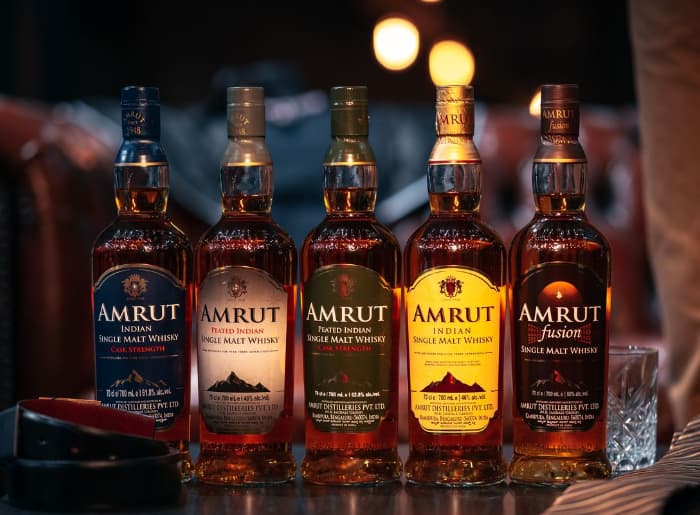
Amrut Distilleries, based in Bengaluru, launched its single malt whisky internationally in 2004, marking a key moment in establishing India as a whisky-producing nation. In 2010, Amrut truly gained recognition when whisky writer Jim Murray ranked Amrut Fusion third in the world in his Whisky Bible. That was a significant moment that challenged old perceptions of Indian whisky.
Amrut uses Indian barley in many of its expressions, and Amrut Fusion is a blend of Indian barley with peated Scottish barley. The distillery is based in Bengaluru at about 3,000 feet elevation, where the temperature is fairly consistent throughout the year, affecting maturation. The range includes Amrut Fusion, Amrut Peated, Amrut Cask Strength, and several special expressions using different casks and finishes.
.jpg&w=1920&q=75)
Made by Piccadily Distilleries in Haryana, Indri entered the Indian single malt market in 2021. Unlike Amrut, which has its distillery in the elevated Bengaluru area, Indri matures its whisky in the plains of northern India, where the seasonal temperature swing is huge (hot summers, cold winters). They use Indian six-row barley and have a distinct approach to cask maturation.
Indri gained international acclaim in 2023 when its Diwali Collector's Edition won Best in Show Double Gold at the Whiskies of the World competition. The flagship Indri Trini is a whisky matured in ex-bourbon, ex-French red wine, and ex-Pedro Ximénez sherry casks, resulting in a rich, fruity whisky that is quite different from the peated expressions of Amrut.
.jpg&w=1920&q=75)
Although both brands produce Indian single malt whisky, the experience is very different due to their distinct approaches to production and maturation. Amrut's distillery in Bengaluru has a fairly consistent, warm climate, whereas Indri's distillery in Haryana has a much more seasonal climate with greater temperature variation. Both factors impact how the whisky interacts with the oak.
Their ingredients and cask choices also define their individual styles. Amrut uses Indian barley in conjunction with Scottish peated barley (e.g., in the Fusion range), while Indri uses Indian six-row barley. Amrut experiments with ex-bourbon, new oak, and various specialty cask finishes, whereas Indri Trini is known for its ex-bourbon, French red wine, and PX sherry cask finishes.
Produced in Bengaluru, Karnataka, at around 3000ft, they launched their single malt internationally in 2004, and that was a major factor in establishing India's profile in the global whisky market. Indri on the other hand is made by Piccadilly Distilleries in Haryana, North India. Launched in 2021, it has since gained global recognition for its award-winning expressions (the 2023 Diwali Collector's Edition being the most notable).
Amrut uses Indian barley in many of its expressions and incorporates Scottish peated barley into some of its whiskies (Amrut Fusion, for example). This allows them to produce both unpeated and peated whiskies. Whereas Indri uses Indian six-row barley, with its distinct Trini expression achieved by aging in three different types of oak casks.
Amrut uses a range of casks (ex-bourbon, ex-sherry, ex-make, etc.) for various expressions, and the approach to maturation gives the whiskies their range of flavors, from fruit and vanilla to oak, spice, and smoke. Indri is a blend of ex-bourbon, French red wine, and PX (Pedro Ximénez) sherry casks. This gives the spirit its sweetness, dried fruit, and warming spice.
Wondering which Indian single malt whisky is worth trying? Explore how Amrut and Indri compare in taste, maturation, and popular expressions to find your perfect pick.
Depending on the expression, you'll get tropical fruit, honey, malt, cocoa, oak, spice, and peat smoke. Amrut Fusion is ideal for those who enjoy a more robust, lightly smoky whisky. Indri Trini is generally a sweeter-style whisky, with notes of honey, peach, pineapple, raisins, and baking spices. It's a very rounded whisky and can be quite approachable for those new to Indian single malts.
Amrut Fusion is typically bottled at 50% ABV, and Amrut Cask Strength is available at higher strengths (61.8% ABV, for example), whereas Indri Trini is bottled at 46% ABV, Indri DRU Cask Strength is at 57.2% ABV.
.jpg&w=1920&q=75)
If you're already a fan of smoky Scotch, then Amrut Fusion or Amrut Peated would be a sensible place to start. Fusion is a blend of fruit, malt, spice, and a touch of gentle peat smoke. Amrut Peated is more peaty, and Amrut Cask Strength is an option for more experienced drinkers who like their whisky at a higher strength.
Indri Trini is worth trying if you're looking for a sweeter, fruitier style of whisky with plenty of honey, vanilla, and spice. Three-cask maturation gives it a very rounded character, which should appeal to both new and experienced whisky drinkers. For a more intense experience, there's Indri DRU at 57.2%.
Confused about whisky terminology? Discover the differences between single malt, grain, and blended whisky, and what makes each style unique.
For this comparison, I explored the official Amrut and Indri websites to understand how their whiskies differ in terms of ingredients, cask maturation, flavor profiles, and alcohol strength. I also looked into their international awards and reports from Condé Nast Traveller India and Moneycontrol to understand how both brands have made a name for themselves. The idea was to go beyond just comparing awards and highlight what makes each Indian single malt worth trying.
Amrut and Indri have both been key in establishing India's reputation in the global single malt whisky arena. Amrut was instrumental in bringing Indian single malts to international markets with its early releases. Indri, in turn, has earned a reputation for its unique approach to maturation and has produced several highly regarded whiskies. They're two very different examples of how Indian climate, Indian barley, and cask selection can all influence whisky.
When it comes to Indri versus Amrut, it really comes down to personal preference. Amrut is definitely worth trying if you're looking for a bold, complex whisky with fruity, spicy, and smoky characteristics. Indri, on the other hand, is a fruit-driven whisky with notes of honey, vanilla, and warm spices. Whether you're new to Indian single malts or looking to add to your collection, there's plenty to discover in either brand.

.jpg&w=3840&q=100)
.jpg&w=3840&q=100)